2016年8月11日星期四
CNC machining part manufactorer
CNC machining part
Email:abramdong@gmail.com
Skype:abramdong
Mobile /whatsapp:008613260091203
Machining is any of various processes in which a piece of raw material is cut into a desired final shape and size by a controlled material-removal process. The processes that have this common theme, controlled material removal, are today collectively known as subtractive manufacturing, in distinction from processes of controlled material addition, which are known as additive manufacturing. Exactly what the "controlled" part of the definition implies can vary, but it almost always implies the use of machine tools (in addition to just power tools and hand tools).
Machining is a part of the manufacture of many metal products, but it can also be used on materials such as wood, plastic, ceramic, and composites.A person who specializes in machining is called a machinist. A room, building, or company where machining is done is called a machine shop. Machining can be a business, a hobby, or both. Much of modern day machining is carried out by computer numerical control (CNC), in which computers are used to control the movement and operation of the mills, lathes, and other cutting machines.
The three principal machining processes are classified as turning, drilling and milling. Other operations falling into miscellaneous categories include shaping, planing, boring, broaching and sawing.
Turning operations are operations that rotate the workpiece as the primary method of moving metal against the cutting tool. Lathes are the principal machine tool used in turning.
Milling operations are operations in which the cutting tool rotates to bring cutting edges to bear against the workpiece. Milling machines are the principal machine tool used in milling.
Drilling operations are operations in which holes are produced or refined by bringing a rotating cutter with cutting edges at the lower extremity into contact with the workpiece. Drilling operations are done primarily in drill presses but sometimes on lathes or mills.
Miscellaneous operations are operations that strictly speaking may not be machining operations in that they may not be swarf producing operations but these operations are performed at a typical machine tool. Burnishing is an example of a miscellaneous operation. Burnishing produces no swarf but can be performed at a lathe, mill, or drill press.
machining part factory from China
machining part
Email:abramdong@gmail.com
Skype:abramdong
Mobile /whatsapp:008613260091203
Machining is any of various processes in which a piece of raw material is cut into a desired final shape and size by a controlled material-removal process. The processes that have this common theme, controlled material removal, are today collectively known as subtractive manufacturing, in distinction from processes of controlled material addition, which are known as additive manufacturing. Exactly what the "controlled" part of the definition implies can vary, but it almost always implies the use of machine tools (in addition to just power tools and hand tools).
Machining is a part of the manufacture of many metal products, but it can also be used on materials such as wood, plastic, ceramic, and composites.[1] A person who specializes in machining is called a machinist. A room, building, or company where machining is done is called a machine shop. Machining can be a business, a hobby, or both. Much of modern day machining is carried out by computer numerical control (CNC), in which computers are used to control the movement and operation of the mills, lathes, and other cutting machines.
The three principal machining processes are classified as turning, drilling and milling. Other operations falling into miscellaneous categories include shaping, planing, boring, broaching and sawing.
Turning operations are operations that rotate the workpiece as the primary method of moving metal against the cutting tool. Lathes are the principal machine tool used in turning.
Milling operations are operations in which the cutting tool rotates to bring cutting edges to bear against the workpiece. Milling machines are the principal machine tool used in milling.
Drilling operations are operations in which holes are produced or refined by bringing a rotating cutter with cutting edges at the lower extremity into contact with the workpiece. Drilling operations are done primarily in drill presses but sometimes on lathes or mills.
Miscellaneous operations are operations that strictly speaking may not be machining operations in that they may not be swarf producing operations but these operations are performed at a typical machine tool. Burnishing is an example of a miscellaneous operation. Burnishing produces no swarf but can be performed at a lathe, mill, or drill press.
Email:abramdong@gmail.com
Skype:abramdong
Mobile /whatsapp:008613260091203
Machining is any of various processes in which a piece of raw material is cut into a desired final shape and size by a controlled material-removal process. The processes that have this common theme, controlled material removal, are today collectively known as subtractive manufacturing, in distinction from processes of controlled material addition, which are known as additive manufacturing. Exactly what the "controlled" part of the definition implies can vary, but it almost always implies the use of machine tools (in addition to just power tools and hand tools).
Machining is a part of the manufacture of many metal products, but it can also be used on materials such as wood, plastic, ceramic, and composites.[1] A person who specializes in machining is called a machinist. A room, building, or company where machining is done is called a machine shop. Machining can be a business, a hobby, or both. Much of modern day machining is carried out by computer numerical control (CNC), in which computers are used to control the movement and operation of the mills, lathes, and other cutting machines.
The three principal machining processes are classified as turning, drilling and milling. Other operations falling into miscellaneous categories include shaping, planing, boring, broaching and sawing.
Turning operations are operations that rotate the workpiece as the primary method of moving metal against the cutting tool. Lathes are the principal machine tool used in turning.
Milling operations are operations in which the cutting tool rotates to bring cutting edges to bear against the workpiece. Milling machines are the principal machine tool used in milling.
Drilling operations are operations in which holes are produced or refined by bringing a rotating cutter with cutting edges at the lower extremity into contact with the workpiece. Drilling operations are done primarily in drill presses but sometimes on lathes or mills.
Miscellaneous operations are operations that strictly speaking may not be machining operations in that they may not be swarf producing operations but these operations are performed at a typical machine tool. Burnishing is an example of a miscellaneous operation. Burnishing produces no swarf but can be performed at a lathe, mill, or drill press.
Aluminum die casting part
aluminum die casting part
Email:abramdong@gmail.com
Skype:abramdong
Mobile /whatsapp:008613260091203
Email:abramdong@gmail.com
Skype:abramdong
Mobile /whatsapp:008613260091203
2016年8月10日星期三
laser cutting parts
laser cutting parts
Email:abramdong@gmail.com
Skype:abramdong
Mobile /whatsapp:008613260091203
What is laser cutting?
Laser cutting is a technology that uses a laser to cut materials, and is typically used for industrial manufacturing applications, but is also starting to be used by schools, small
businesses, and hobbyists. Laser cutting works by directing the output of a high-power laser most commonly through optics. The laser optics and CNC (computer numerical control) are used to
direct the material or the laser beam generated. A typical commercial laser for cutting materials would involve a motion control system to follow a CNC or G-code of the pattern to be cut
onto the material. The focused laser beam is directed at the material, which then either melts, burns, vaporizes away, or is blown away by a jet of gas, leaving an edge with a high-quality
surface finish. Industrial laser cutters are used to cut flat-sheet material as well as structural and piping materials.
Email:abramdong@gmail.com
Skype:abramdong
Mobile /whatsapp:008613260091203
What is laser cutting?
Laser cutting is a technology that uses a laser to cut materials, and is typically used for industrial manufacturing applications, but is also starting to be used by schools, small
businesses, and hobbyists. Laser cutting works by directing the output of a high-power laser most commonly through optics. The laser optics and CNC (computer numerical control) are used to
direct the material or the laser beam generated. A typical commercial laser for cutting materials would involve a motion control system to follow a CNC or G-code of the pattern to be cut
onto the material. The focused laser beam is directed at the material, which then either melts, burns, vaporizes away, or is blown away by a jet of gas, leaving an edge with a high-quality
surface finish. Industrial laser cutters are used to cut flat-sheet material as well as structural and piping materials.
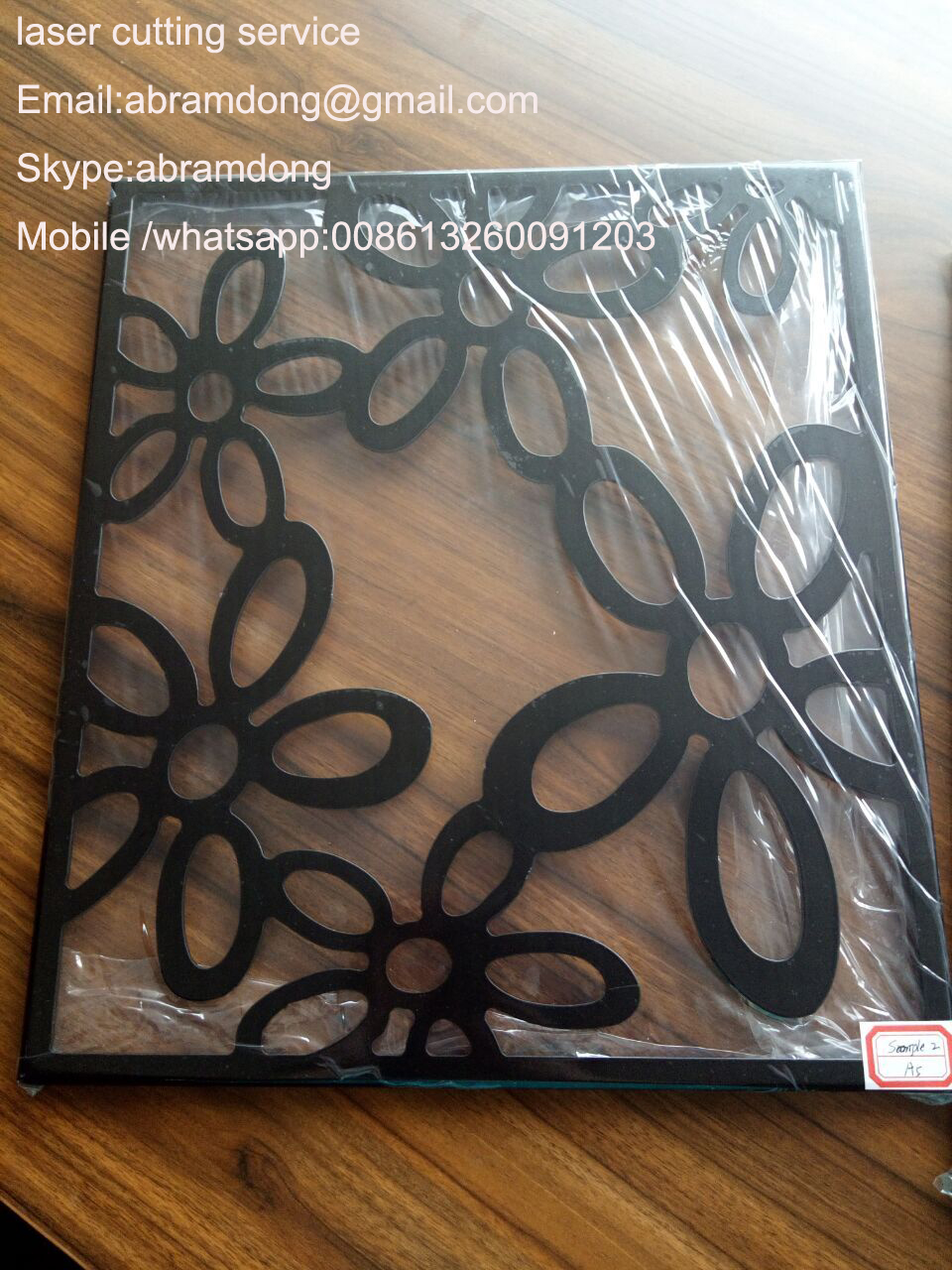
laser cutting service
Email:abramdong@gmail.com
Skype:abramdong
Mobile /whatsapp:008613260091203
What is laser cutting?
Laser cutting is a technology that uses a laser to cut materials, and is typically used for industrial manufacturing applications, but is also starting to be used by schools, small businesses, and hobbyists. Laser cutting works by directing the output of a high-power laser most commonly through optics. The laser optics and CNC (computer numerical control) are used to direct the material or the laser beam generated. A typical commercial laser for cutting materials would involve a motion control system to follow a CNC or G-code of the pattern to be cut onto the material. The focused laser beam is directed at the material, which then either melts, burns, vaporizes away, or is blown away by a jet of gas, leaving an edge with a high-quality surface finish. Industrial laser cutters are used to cut flat-sheet material as well as structural and piping materials.
2016年6月13日星期一
Machining Process
Machining is a term used to describe a variety of material removal processes in which a cutting tool removes unwanted material from a workpiece to produce the desired shape. The workpiece is typically cut from a larger piece of stock, which is available in a variety of standard shapes, such as flat sheets, solid bars, hollow tubes, and shaped beams. Machining can also be performed on an existing part, such as a casting or forging.
Parts that are machined from a pre-shaped workpiece are typically cubic or cylindrical in their overall shape, but their individual features may be quite complex. Machining can be used to create a variety of features including holes, slots, pockets, flat surfaces, and even complex surface contours. Also, while machined parts are typically metal, almost all materials can be machined, including metals, plastics, composites, and wood. For these reasons, machining is often considered the most common and versatile of all manufacturing processes.
As a material removal process, machining is inherently not the most economical choice for a primary manufacturing process. Material, which has been paid for, is cut away and discarded to achieve the final part. Also, despite the low setup and tooling costs, long machining times may be required and therefore be cost prohibitive for large quantities. As a result, machining is most often used for limited quantities as in the fabrication of prototypes or custom tooling for other manufacturing processes. Machining is also very commonly used as a secondary process, where minimal material is removed and the cycle time is short. Due to the high tolerance and surface finishes that machining offers, it is often used to add or refine precision features to an existing part or smooth a surface to a fine finish.
As mentioned above, machining includes a variety of processes that each removes material from an initial workpiece or part. The most common material removal processes, sometimes referred to as conventional or traditional machining, are those that mechanically cut away small chips of material using a sharp tool. Non-conventional machining processes may use chemical or thermal means of removing material. Conventional machining processes are often placed in three categories - single point cutting, multi-point cutting, and abrasive machining. Each process in these categories is uniquely defined by the type of cutting tool used and the general motion of that tool and the workpiece. However, within a given process a variety of operations can be performed, each utilizing a specific type of tool and cutting motion. The machining of a part will typically require a variety of operations that are performed in a carefully planned sequence to create the desired features.
Material removal processes
Mechanical
Single-point cutting
Turning
Planing and shaping
Multi-point cutting
Milling
Drilling
Broaching
Sawing
Abrasive machining
Grinding
Honing
Lapping
Ultrasonic machining
Abrasive jet machining
Chemical
Chemical machining
Electrochemical machining (ECM)
Thermal
Torch cutting
Electrical discharge machining (EDM)
High energy beam machining
Single point cutting refers to using a cutting tool with a single sharp edge that is used to remove material from the workpiece. The most common single point cutting process is turning, in which the workpiece rotates and the cutting tool feeds into the workpiece, cutting away material. Turning is performed on a lathe or turning machine and produces cylindrical parts that may have external or internal features. Turning operations such as turning, boring, facing, grooving, cut-off (parting), and thread cutting allow for a wide variety of features to be machined, including slots, tapers, threads, flat surfaces, and complex contours. Other single point cutting processes exist that do not require the workpiece to rotate, such as planing and shaping.
Multi-point cutting refers to using a cutting tool with many sharp teeth that moves against the workpiece to remove material. The two most common multi-point cutting processes are milling and drilling. In both processes, the cutting tool is cylindrical with sharp teeth around its perimeter and rotates at high speeds. In milling, the workpiece is fed into the rotating tool along different paths and depths to create a variety of features. Performed on a milling machine, milling operations such as end milling, chamfer milling, and face milling are used to create slots, chamfers, pockets, flat surfaces, and complex contours. Milling machines can also perform drilling and other hole-making operations as well.
Abrasive machining refers to using a tool formed of tiny abrasive particles to remove material from a workpiece. Abrasive machining is considered a mechanical process like milling or turning because each particle cuts into the workpiece removing a small chip of material. While typically used to improve the surface finish of a part, abrasive machining can still be used to shape a workpiece and form features. The most common abrasive machining process is grinding, in which the cutting tool is abrasive grains bonded into a wheel that rotates against the workpiece. Grinding may be performed on a surface grinding machine which feeds the workpiece into the cutting tool, or a cylindrical grinding machine which rotates the workpiece as the cutting tool feeds into it. Other abrasive machining processes use particles in other ways, such as attached to a soft material or suspended in a liquid. Such processes include honing, lapping, ultrasonic machining, and abrasive jet machining.
Parts that are machined from a pre-shaped workpiece are typically cubic or cylindrical in their overall shape, but their individual features may be quite complex. Machining can be used to create a variety of features including holes, slots, pockets, flat surfaces, and even complex surface contours. Also, while machined parts are typically metal, almost all materials can be machined, including metals, plastics, composites, and wood. For these reasons, machining is often considered the most common and versatile of all manufacturing processes.
As a material removal process, machining is inherently not the most economical choice for a primary manufacturing process. Material, which has been paid for, is cut away and discarded to achieve the final part. Also, despite the low setup and tooling costs, long machining times may be required and therefore be cost prohibitive for large quantities. As a result, machining is most often used for limited quantities as in the fabrication of prototypes or custom tooling for other manufacturing processes. Machining is also very commonly used as a secondary process, where minimal material is removed and the cycle time is short. Due to the high tolerance and surface finishes that machining offers, it is often used to add or refine precision features to an existing part or smooth a surface to a fine finish.
As mentioned above, machining includes a variety of processes that each removes material from an initial workpiece or part. The most common material removal processes, sometimes referred to as conventional or traditional machining, are those that mechanically cut away small chips of material using a sharp tool. Non-conventional machining processes may use chemical or thermal means of removing material. Conventional machining processes are often placed in three categories - single point cutting, multi-point cutting, and abrasive machining. Each process in these categories is uniquely defined by the type of cutting tool used and the general motion of that tool and the workpiece. However, within a given process a variety of operations can be performed, each utilizing a specific type of tool and cutting motion. The machining of a part will typically require a variety of operations that are performed in a carefully planned sequence to create the desired features.
Material removal processes
Mechanical
Single-point cutting
Turning
Planing and shaping
Multi-point cutting
Milling
Drilling
Broaching
Sawing
Abrasive machining
Grinding
Honing
Lapping
Ultrasonic machining
Abrasive jet machining
Chemical
Chemical machining
Electrochemical machining (ECM)
Thermal
Torch cutting
Electrical discharge machining (EDM)
High energy beam machining
Single point cutting refers to using a cutting tool with a single sharp edge that is used to remove material from the workpiece. The most common single point cutting process is turning, in which the workpiece rotates and the cutting tool feeds into the workpiece, cutting away material. Turning is performed on a lathe or turning machine and produces cylindrical parts that may have external or internal features. Turning operations such as turning, boring, facing, grooving, cut-off (parting), and thread cutting allow for a wide variety of features to be machined, including slots, tapers, threads, flat surfaces, and complex contours. Other single point cutting processes exist that do not require the workpiece to rotate, such as planing and shaping.
Multi-point cutting refers to using a cutting tool with many sharp teeth that moves against the workpiece to remove material. The two most common multi-point cutting processes are milling and drilling. In both processes, the cutting tool is cylindrical with sharp teeth around its perimeter and rotates at high speeds. In milling, the workpiece is fed into the rotating tool along different paths and depths to create a variety of features. Performed on a milling machine, milling operations such as end milling, chamfer milling, and face milling are used to create slots, chamfers, pockets, flat surfaces, and complex contours. Milling machines can also perform drilling and other hole-making operations as well.
Abrasive machining refers to using a tool formed of tiny abrasive particles to remove material from a workpiece. Abrasive machining is considered a mechanical process like milling or turning because each particle cuts into the workpiece removing a small chip of material. While typically used to improve the surface finish of a part, abrasive machining can still be used to shape a workpiece and form features. The most common abrasive machining process is grinding, in which the cutting tool is abrasive grains bonded into a wheel that rotates against the workpiece. Grinding may be performed on a surface grinding machine which feeds the workpiece into the cutting tool, or a cylindrical grinding machine which rotates the workpiece as the cutting tool feeds into it. Other abrasive machining processes use particles in other ways, such as attached to a soft material or suspended in a liquid. Such processes include honing, lapping, ultrasonic machining, and abrasive jet machining.
订阅:
博文 (Atom)